

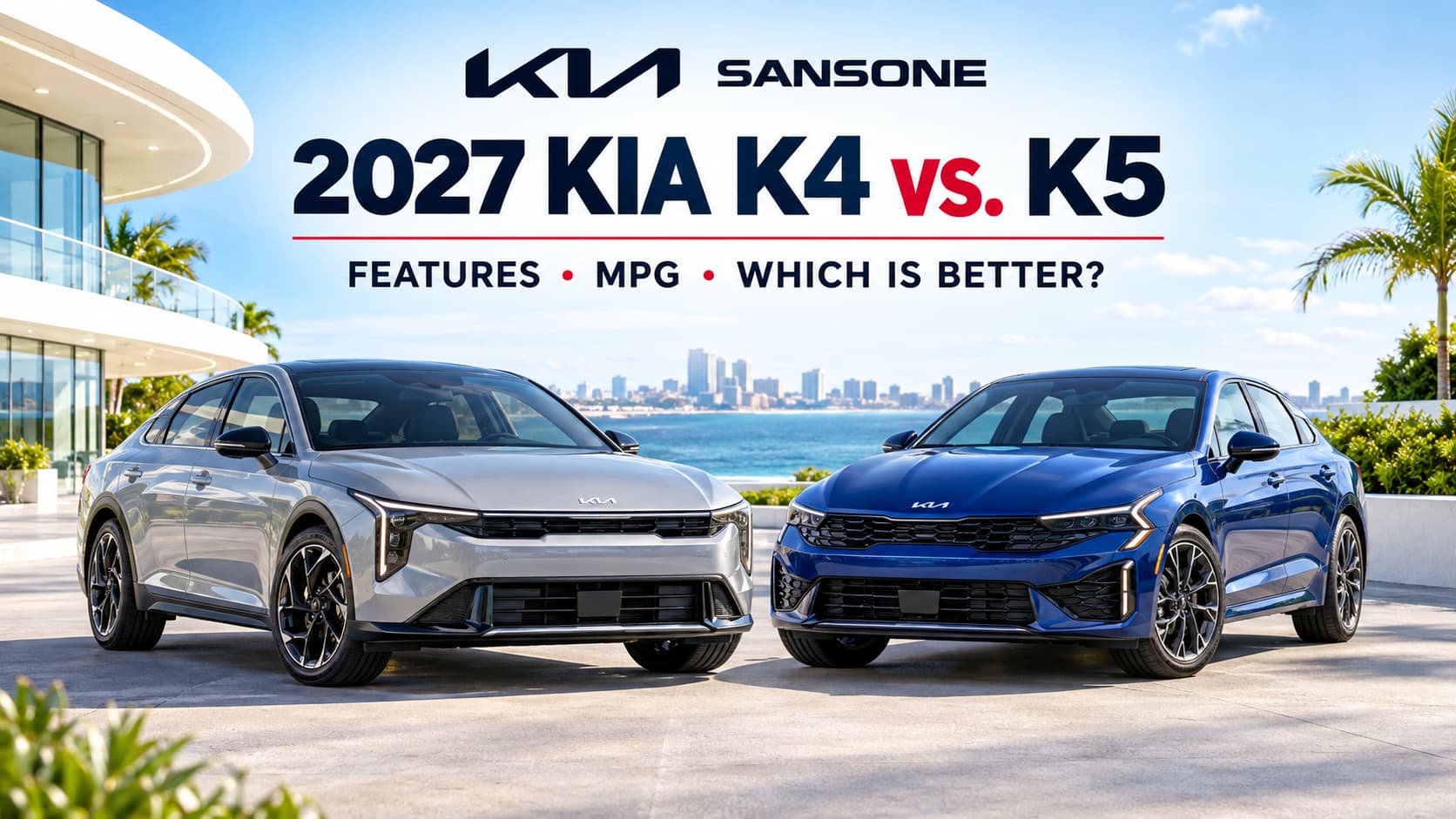
If you're trying to decide between the 2027 Kia K4 and the K5, you're comparing two sedans that share a brand but serve different buyers. The K4 is a compact sedan that also comes as a hatchback, available across five trim levels. The K5 is a mid-size sedan with a longer cabin and a turbocharged GT trim producing 290 horsepower. The right call depends on what you actually need the car to do.
How Do the Kia K4 and K5 Trim Levels Compare?
The K4 sedan is offered in five trims: LX, LXS, EX, GT-Line, and GT-Line Turbo. A hatchback body is available separately in EX, GT-Line, and GT-Line Turbo configurations.
The Kia K5 comes in three trims: LXS, GT-Line, and GT. The K5 offers three trims, including the performance-focused GT, while the K4 offers five sedan trims with different equipment and powertrain options. The K5 GT-Line also offers AWD as an option, something unavailable on any K4 trim.
2027 Kia K4 vs K5: Engine and Performance
Which Gets Better Fuel Economy?
The K4's non-turbo trims lead at 33 mpg combined. The K5 LXS FWD's 37 mpg highway figure is competitive for longer commutes, but across the full combined figure the K4 holds the advantage.
How Much Space Do You Get?
The K5 has a longer wheelbase and overall length, but buyers should compare the published rear-seat dimensions and seating comfort separately. The K4 hatchback is worth considering if cargo access matters more than trunk depth.
Features: What Do You Get Standard?
On both cars, every trim includes:
Both the K4 and K5 come with wireless Apple CarPlay and Android Auto on every trim, with no cable required.
Forward collision avoidance is standard across the board, covering vehicles, pedestrians, and cyclists.
Smart cruise control with stop-and-go is included from the base trim on both models, which is not a given in this segment.
Lane keep assist, lane following assist, and a rear-view camera are fitted as standard on every trim of both cars.
Both models include rear USB-C ports and an electronic parking brake with auto-hold regardless of trim level.
K4 GT-Line Turbo adds:
The GT-Line Turbo upgrades to a 12.3-inch digital instrument cluster, replacing the smaller TFT display on lower trims.
The Harman Kardon 8-speaker premium audio system is available on the K4 GT-Line through the GT-Line Premium Package; it is not listed as an available feature for the GT-Line Turbo in the 2026 K4 sedan's official package information.
K5 GT-Line and GT add:
The GT-Line and GT both include full navigation and voice recognition built into the 12.3-inch infotainment system.
Highway Driving Assist is standard on the K5 GT-Line and GT, while its availability on the K4 depends on trim and package.
The Bose 12-speaker premium audio system with Active Sound Design is available on the K5 GT-Line through the GT-Line Premium Package and on the GT through the GT1 Package.
K5 GT exclusively includes:
The K5 GT comes standard with a panoramic sunroof, while the GT-Line offers it through the available GT-Line Premium Package.
Sport-tuned suspension and paddle shifters are fitted from the factory on the GT.
The GT rides on 19-inch alloy wheels with distinctively finished green brake calipers.
Kia’s K4 GT-Line Turbo Technology Package includes available Surround View Monitor and Blind-Spot View Monitor. These systems are available on appropriately equipped versions of both models.
Kia K4 vs K5: Which One Should You Buy?
The K4 makes more sense if:
Fuel efficiency is a top priority, since its non-turbo trims return 33 mpg combined — the best figure between the two models.
You want the option of a hatchback body, which the K5 doesn't offer in any configuration.
You don't need AWD or a larger rear cabin and would rather stay in the compact segment.
You want a well-equipped car with strong standard safety tech without moving into mid-size territory.
The K5 makes more sense if:
You regularly seat taller adults in the back row and need the extra legroom the longer wheelbase provides.
AWD is a requirement, since the K5 GT-Line is the only trim across both models that offers it.
The 290 hp GT's performance numbers are what you're shopping for specifically.
K5 GT includes a standard panoramic sunroof, while the GT-line offers one through its Premium package.
The K5 earns its place at GT-Line and GT trim levels specifically. Below that, the K4 GT-Line Turbo is the stronger value, more standard technology in a segment-appropriate package.
Visit Sansone Kia
Sansone Kia displays 2027 K4, K4 Hatchback and K5 entries, making it a useful static destination for both models. Visit Sansone Kia at 90-100 US Highway 1 North, Woodbridge, NJ 07001. The sales team is available Monday through Friday from 9:00 AM to 8:00 PM and Saturday from 9:00 AM to 7:00 PM. You can also call at 800-726-7663 or browse current inventory.
FAQs
What is the main difference between the Kia K4 and K5?
The K4 is a compact sedan with better base fuel economy and an available hatchback body. The K5 is a mid-size sedan with a longer wheelbase, more rear passenger space, and a 290 hp turbocharged GT trim.
Which car gets better gas mileage, the K4 or K5?
The K4's non-turbo trims return 33 mpg combined (29 city / 39 highway), making them the more fuel-efficient option. The K5 LXS FWD returns 30 mpg combined. Both the K4 GT-Line Turbo and K5 GT return 27 to 28 mpg combined.
Does the 2027 Kia K4 come with AWD?
No. Kia's official specifications confirm the 2027 K4 is front-wheel drive across all trims. AWD is available only on the K5, specifically on the GT-Line trim.
Does the Kia K5 come in a hatchback?
No. The K5 is only available as a sedan. The K4 is the model in Kia's lineup that offers a hatchback body style, available in EX, GT-Line, and GT-Line Turbo configurations.
Which Kia sedan is better for highway driving?
The K5 LXS FWD returns 37 mpg on the highway, the highest highway figure between the two models. For buyers who spend most of their time on highways, the K5 LXS has a slight edge. For combined efficiency across city and highway driving, the K4's non-turbo trims still lead at 33 mpg combined.

 Warranties include 10-year/100,000-mile powertrain and 5-year/60,000-mile basic. All warranties and roadside assistance are limited. See retailer for warranty details.